Health & Safety
Mold Symptoms at Home: What Exposure Actually Feels Like
Mold exposure symptoms are usually allergy-like: congestion, cough, itchy eyes, worse asthma. Here's the pattern that points at your house — and when to worry.
Quick answers
What are the most common mold exposure symptoms? Nasal congestion, sneezing, a lingering dry cough, itchy or watery eyes, throat irritation, and worsening asthma — allergy-like symptoms, not dramatic ones.
Is "toxic black mold" making me sick? For most people, household mold is an allergen and irritant issue; the popular idea that black mold causes severe poisoning in ordinary homes is widely overstated by public health authorities.
How do I know the symptoms are from my house? Look for a pattern: symptoms that ease within hours or days when you're away and return when you come home, or that flare in one specific room.
Do I need a doctor or an inspector first? Both, in parallel — a doctor for symptoms that persist, worsen, or involve breathing trouble; an inspector for visible growth over roughly 10 square feet, hidden growth, or suspected HVAC contamination.
What actually fixes it? Finding and correcting the moisture source, then removing the mold — air purifiers and bleach sprays don't solve a leak.
If you've searched "signs of mold sickness" at 11 p.m. after finding a dark patch behind the dresser, take a breath. The internet's version of mold exposure is a lot scarier than what most people actually experience. Here's a calmer, more accurate picture — what symptoms are commonly reported, who tends to be affected, how to tell if your house is the culprit, and what to do about it.
One thing up front, and we'll repeat it: nothing here is medical advice, and no article — or photo tool — can diagnose you. What we can do is help you read the pattern and know who to call.
What mold exposure usually feels like
For most people, mold acts like any other airborne allergen: pollen, dust mites, pet dander. Your immune system reacts to spores and fragments in the air, and you get upper-respiratory and irritation symptoms.
Commonly reported mold symptoms include:
- Nasal congestion or a runny nose that doesn't track with a cold's usual one-week arc
- Sneezing fits, often in a particular room or right after doing laundry in the basement
- A dry, nagging cough or throat tickle, worse at night
- Itchy, red, or watery eyes
- Wheezing or chest tightness, especially in people with asthma
- Skin irritation or rash in some people, usually after direct contact with moldy material
- Headaches or a general foggy, worn-down feeling — real, commonly described, and also extremely nonspecific
Notice what's not on that list: fever, vomiting, bleeding, neurological damage. Those are the claims that circulate in mold panic content, and they aren't what public health agencies like the CDC and EPA describe for typical indoor mold exposure in homes.
Two other categories are worth naming because they're real but uncommon in healthy adults:
- Asthma attacks triggered or worsened by damp, moldy environments. This is the best-documented and most important risk. If someone in the house has asthma, damp indoor conditions matter.
- Infections and serious lung reactions. These are largely confined to people with significantly weakened immune systems — chemotherapy patients, transplant recipients, people with advanced lung disease. That's a genuine medical concern, and it's handled by their doctors, not by a blog post.
Symptoms are the vaguest possible evidence
Congestion, cough, fatigue, headache — that list also describes a cold, seasonal allergies, sinus infection, poor sleep, dehydration, a new pet, a dusty furnace filter, and about forty other things. Symptoms alone almost never tell you mold is the cause. The pattern is what tells you something.
The pattern that actually points at your house
This is the single most useful diagnostic clue a homeowner has, and it costs nothing:
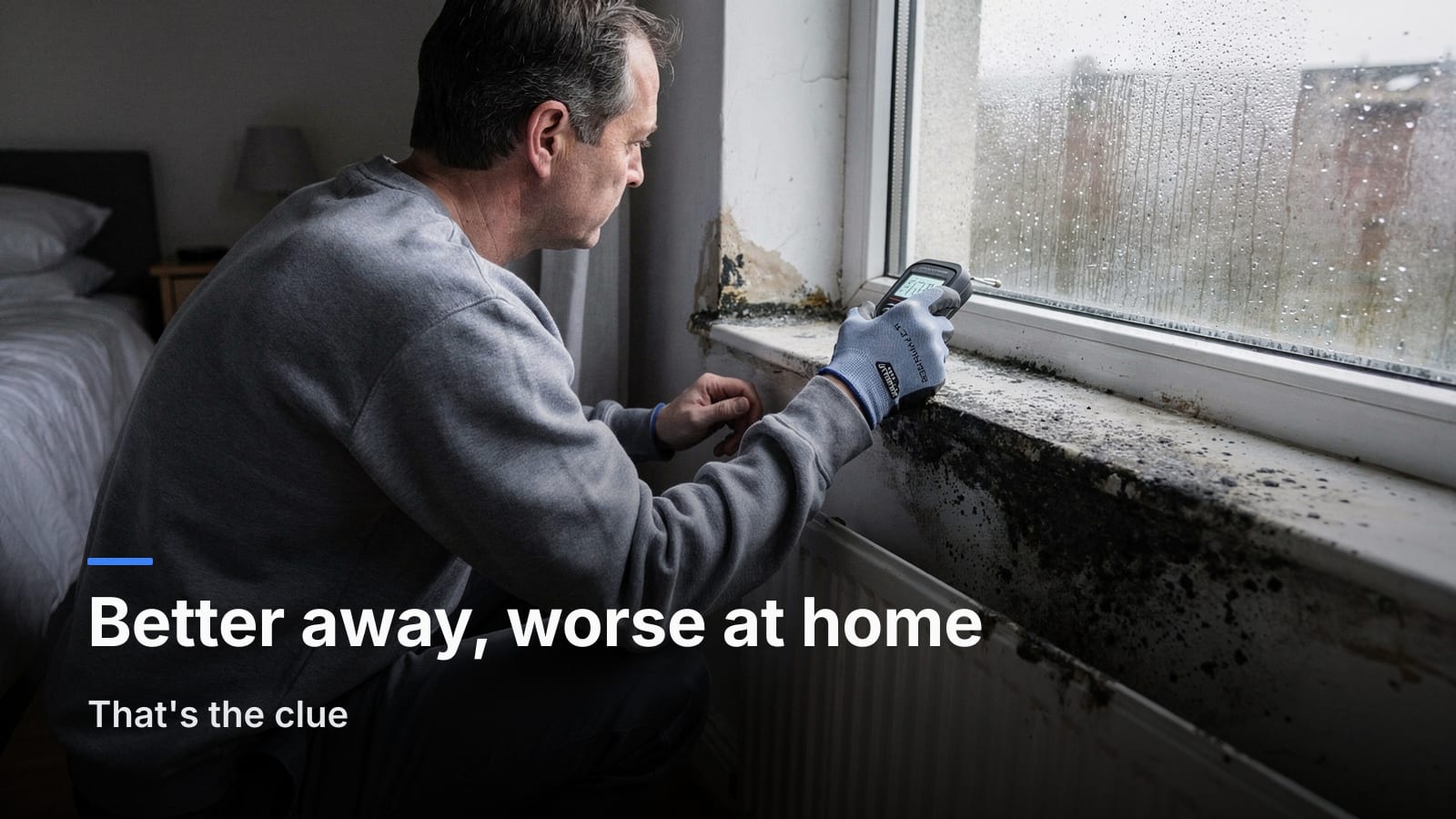
Do your symptoms improve when you leave, and return when you come back?
Think about the last time you spent a few days somewhere else — a hotel, a relative's house, a work trip. Did the congestion lift? Did the cough quiet down by day two, then creep back the night you got home? That "better away, worse at home" rhythm is a strong hint that something in the building is involved. It doesn't prove it's mold — could be dust, a gas appliance, a pet, or a cleaning product — but it moves the investigation indoors.
Other patterns worth noticing:
- Room-specific symptoms. You get stuffy within twenty minutes in the finished basement and fine everywhere else.
- Season-specific symptoms. Worse in humid summer months, or right after the rainy stretch that flooded the crawlspace.
- Symptoms that started after a water event. A washing machine overflow, a roof leak, a burst pipe — and two weeks later everybody's coughing.
- More than one person (or the dog) affected. A household-wide pattern is more suggestive than one person feeling run down.
- A musty smell you can't place. Your nose is a decent mold detector. If you smell it but can't find it, there's a whole method for tracking down hidden growth.
Conversely, if you feel exactly the same on vacation as you do at home, a mold problem in your house is a less likely explanation for how you feel — even if you do have mold on the window sill worth cleaning.
Who's more sensitive
Mold affects people unevenly. Two roommates can live in the same damp apartment and one is miserable while the other notices nothing. Groups more likely to react, per general public health guidance:
- People with mold or mildew allergies — the most direct case
- People with asthma, especially children
- Infants and young children
- Older adults
- People with chronic lung conditions like COPD
- People who are immunocompromised — the group with the highest stakes and the clearest reason to act quickly
If someone in one of these groups lives in the home, don't wait around to see if a damp problem resolves on its own. Treat it as a maintenance priority, not a mystery to solve.
About "toxic black mold"
The scary version goes like this: Stachybotrys chartarum produces mycotoxins, mycotoxins are poisonous, therefore black mold in your bathroom is poisoning your family.
The reality is more boring. Yes, some molds can produce mycotoxins under certain growth conditions. But producing a compound in a petri dish isn't the same as delivering a meaningful dose to a person breathing in a room. Public health agencies have consistently said the evidence doesn't support the dramatic "toxic mold syndrome" claims that circulate online, and that the practical advice for every mold is the same regardless of species.
That last part is the useful takeaway: you don't need to know which mold you have to know what to do about it. Any significant mold growth means there's water where it shouldn't be. Fix the water, remove the growth, done. Paying for species identification rarely changes a homeowner's next step. If you're curious about what actually distinguishes the notorious species from the everyday ones, we broke that down in Stachybotrys vs. other common molds.
What black mold is worth treating as is a signal of serious, sustained moisture. Stachybotrys tends to show up on chronically wet cellulose — soaked drywall, saturated wood, backed-up ceiling tile. If you see it, you probably have a plumbing or roofing problem, and that's the emergency, not the mold color.
When to see a doctor
See a healthcare provider if:
- Symptoms persist more than a couple of weeks without a clear explanation
- You have shortness of breath, wheezing, or chest tightness — don't wait on this one
- Asthma is getting harder to control, or a rescue inhaler is getting more use
- A child's cough or congestion is chronic and unexplained
- You are immunocompromised and have any respiratory symptoms
- You're simply worried and want it checked out — that's reason enough
Tell your provider plainly: "I've found mold in my home, and my symptoms improve when I'm away." That's actionable information. They may test for mold allergies, treat the symptoms, or refer you to an allergist. What they generally won't do is order a "mold toxicity panel" — be cautious with clinics that heavily market those, because interpreting them is contested and the tests can be expensive.
When to call an inspector or remediation pro
Health symptoms are the reason to investigate. The building tells you whether to hire someone. Common thresholds:
- Visible growth larger than about 10 square feet (roughly a 3x3 patch) — the widely cited line where EPA guidance suggests professional help
- Hidden growth — you smell it, you can't find it, or you suspect it's inside a wall cavity or under flooring
- Recurring growth — you clean the same spot and it keeps coming back, which means the moisture source is still active
- HVAC involvement — suspected mold in ducts or the air handler spreads spores building-wide; if you're seeing dark specks around your vents, get it looked at rather than guessing
- Sewage, flooding, or long-standing water damage
- Someone in the house is in a sensitive group and symptomatic
Small stuff — a patch of mildew on shower grout, a bit of growth on a window sill — is normal DIY territory. Gloves, an N95, ventilation, a detergent solution, and no dry-scraping or dry-brushing that flings spores into the air.
What actually solves it: the moisture, not the mold
Mold is the symptom. Water is the disease. Wiping a wall without fixing the source just resets the clock.
Work through the usual suspects:
- Relative humidity. Aim for roughly 30–50%. A $15 hygrometer will tell you more about your mold risk than any air test. Dehumidify basements in summer.
- Ventilation. Run bathroom fans during showers and for 20–30 minutes after. Use the kitchen hood. Check that the dryer vents outside.
- Leaks. Under sinks, around toilets, at the water heater, the roof, the gutters, the grading against the foundation.
- Cold surfaces. Condensation on windows, exterior walls, and uninsulated pipes feeds mold in the same spots year after year.
- Wet materials. Anything soaked for more than 24–48 hours — carpet pad, drywall, insulation — is usually a removal job, not a drying job.
Do those five things and most household mold problems stop recurring. Do none of them and you'll be cleaning the same corner every spring.
A reasonable order of operations
If you found a spot and you're not feeling great, here's a sane sequence:
- Don't panic, and don't disturb it. Scrubbing or sanding dry mold is the one action that reliably makes air quality worse in the short term.
- Note the pattern. Where are you when symptoms hit? Do they ease when you're away?
- Identify what you're looking at. A lot of suspicious spots turn out to be dirt, soot, mineral deposits, or water staining. If you want a fast read before you call anyone, you can upload a photo for an instant AI analysis — it's a screening aid to help you decide how urgently to act, not a lab test or an inspection.
- Find the water. Follow it up, not sideways — stains travel.
- Decide DIY vs. pro using the thresholds above.
- See a doctor if symptoms persist or breathing is involved.
Most of the time this ends undramatically: a bathroom fan that was never used, a window that sweats all winter, a dehumidifier that needed emptying. That's the normal version of this story, and it's the version you're most likely living.
Frequently asked questions
What are the first signs of mold sickness?
Usually the earliest signs are mild and easy to dismiss: a stuffy nose, sneezing, an itchy throat, or eye irritation that you assume is allergies. There's no distinctive "mold symptom" that separates it from other allergens — the giveaway is timing and location, not the symptom itself.
How do I know if my symptoms are from mold in my house?
Track the pattern for a week or two. If you feel noticeably better after a day or two away from home and worse within hours of returning, or if one room reliably sets you off, that points at the building. An allergy test from a doctor can confirm whether you're actually sensitized to mold.
Can mold in the house cause headaches or fatigue?
Headaches and fatigue are commonly reported by people living in damp, moldy homes, though they're also among the least specific symptoms in medicine. They're worth mentioning to your doctor, but they aren't proof of mold exposure on their own, and they shouldn't be the only reason you spend money on testing.
Who is most at risk from mold exposure?
People with mold allergies or asthma, infants and young children, older adults, people with chronic lung disease, and anyone who is immunocompromised. For that last group in particular, damp conditions should be addressed promptly rather than monitored.
Is it safe to sleep in a bedroom where I found mold?
For most healthy adults, one night isn't a crisis, but a bedroom is where you spend eight unventilated hours a night, so it's worth relocating while you sort it out — especially for kids or anyone with asthma. We covered the specifics in this guide to sleeping in a room with mold.
Will an air purifier fix my symptoms?
A HEPA purifier can reduce airborne spores and may help you feel better temporarily, but it does nothing about the colony growing on your wall or the leak feeding it. Treat it as comfort, not as a repair.
If you've found a spot you're unsure about, upload a photo for a free instant analysis — it's a quick first step to help you decide what's worth acting on, not a diagnosis.
Ready to put this into action?
Not sure what you are looking at? Upload a photo and get a free instant mold analysis from Mold Detector AI.
Launch Mold Detector AI