Health & Safety
Is Mold in the Basement Dangerous? What It Means for the Rest of the House
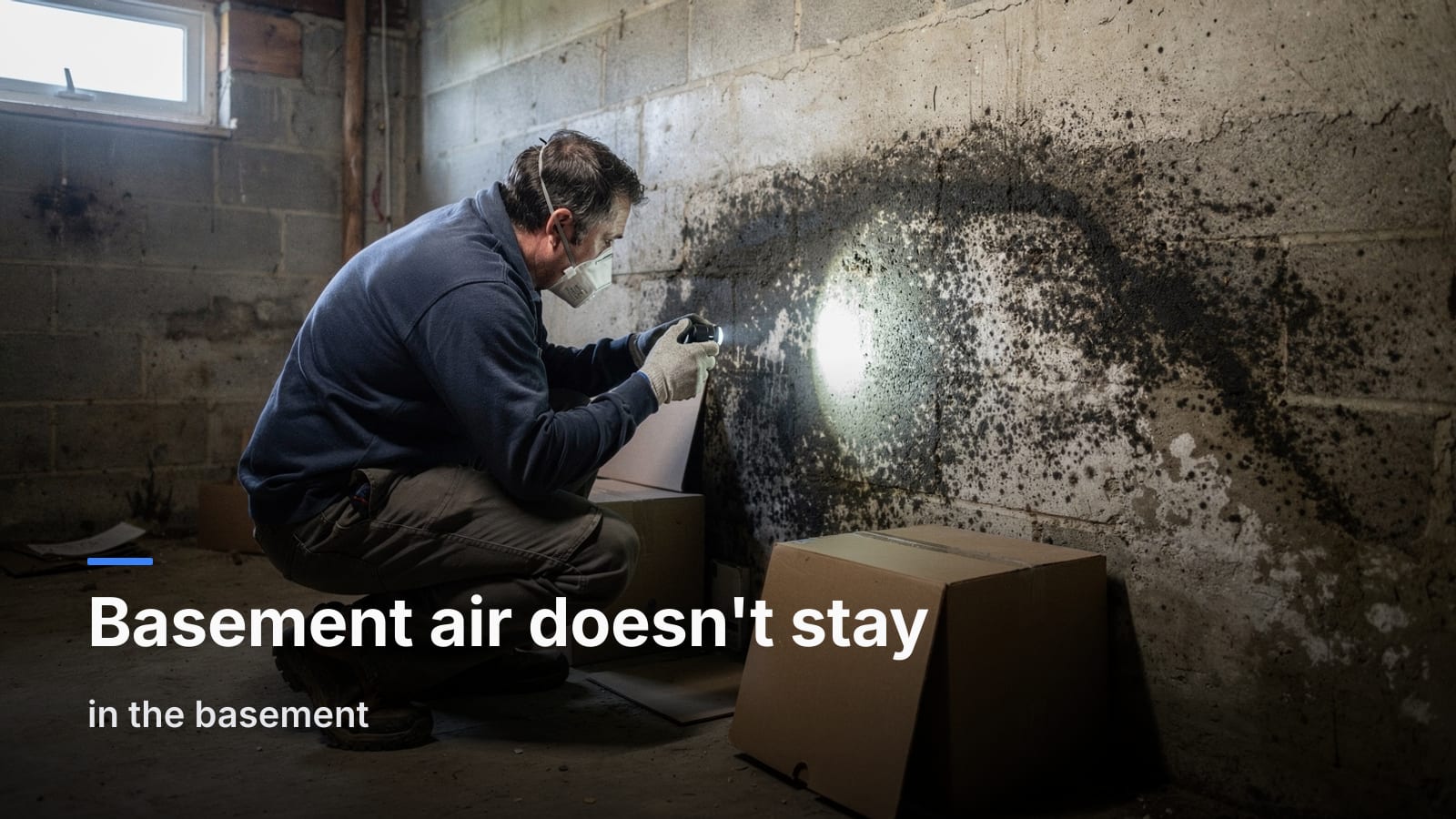
Basement mold rarely stays in the basement. Here's how basement air moves upstairs, which molds are typical, and the right order to fix it: water, humidity, then cleaning.
Fast facts
- Is mold in the basement dangerous? Small patches on hard surfaces are usually a nuisance rather than an emergency, but widespread growth matters because basement air moves upward into the living space all day long.
- Can basement mold affect the upstairs? Yes — warm air rising through a house pulls replacement air in from the lowest level, so basement odors, spores and humidity travel with it.
- What does a musty basement smell mean? It means something down there is damp enough to support microbial growth, even if you can't see a spot yet.
- What's the right order of fixes? Stop the water, then lower the humidity, then clean — cleaning first just resets the clock.
- When should I call a professional? If growth covers more than roughly 10 square feet, keeps returning, is inside finished walls or insulation, or anyone in the house has ongoing symptoms.
Why basements are mold's favorite room
A basement is cool, often dark, frequently damp, and surrounded on all sides by wet soil. Concrete wicks moisture. Air that feels fine upstairs cools as it sinks and its relative humidity climbs. Add cardboard boxes, old furniture, carpet pad, and drywall against a foundation wall, and you've assembled nearly everything mold needs.
The other reason basements are the problem room: nobody lives in them. A bathroom ceiling spot gets noticed in a week. A basement corner can grow quietly for two years behind a stack of holiday bins.
So the honest answer to "is basement mold dangerous" isn't yes or no. It's: it depends on how much there is, how wet the basement is, who lives in the house, and whether the air down there is connected to the air up there. That last part is where most homeowners are surprised.
The stack effect: why basement air doesn't stay in the basement
Houses breathe vertically. Warm indoor air rises and escapes through gaps at the top of the building — attic hatches, recessed lights, plumbing chases, the gaps you can't see. Air that leaves has to be replaced, and the replacement is pulled in at the bottom of the house. In most homes, the bottom of the house is the basement or crawlspace.
This is called the stack effect, and it runs strongest in cold weather when the temperature difference between inside and outside is largest. The practical consequence: a meaningful share of the air you breathe in your living room first passed through your basement.
That's why you can smell a musty basement from the kitchen on a January morning. It's also why "I'll just close the basement door" is not a solution. Basement doors are not air barriers, and the pressure difference doesn't care about a door anyway — the air moves through floor penetrations, stair framing, duct chases, and the gaps around plumbing.
Two more pathways to know about:
- The HVAC system. If your furnace or air handler is in the basement, and the return ducts leak (many do at the seams), the system can actively pull basement air into the ducts and distribute it everywhere. This is the fastest route from "basement problem" to "whole house problem." If you're already seeing dark specks at the registers, it's worth reading our guide to whether black specks in AC vents are dust or mold.
- Humidity migration. Moisture moves independently of air. A basement running at 70% relative humidity raises the moisture load of the whole house, and that shows up as condensation on upstairs window sills in winter.
What basement mold usually looks like
Most of what grows in basements is ordinary and unglamorous. Here's a rough field guide to what you're looking at.
| What you see | Typical look & feel | Where it shows up | What it usually means |
|---|---|---|---|
| White/gray fuzz | Cottony, fuzzy, sits on top of the surface | Joists, subfloor underside, cardboard, leather, furniture | Chronic high humidity, not necessarily liquid water |
| Powdery white crust | Crystalline, crumbles, dissolves in water | Concrete walls and floors, block mortar joints | Efflorescence — mineral salts, not mold, but proof water is moving through the wall |
| Black or dark green spotting | Speckled, flat, may feel slightly slimy when wet | Drywall paper, window wells, behind stored items | Sustained dampness on an organic surface |
| Olive/brown staining on wood | Gray-brown discoloration, no texture | Floor joists, sill plate, bare framing | Could be old mold, could be water staining — check if it's raised |
| Orange or pink film | Slick, wipes off easily | Sump pit, floor drains, utility sink | Usually bacteria, not mold — but it confirms standing water |
| Smell with no visible growth | Earthy, like wet cardboard or a damp cave | Everywhere and nowhere | Growth hidden behind finishes, under carpet, or inside insulation |
Two quick ID tricks. Raised vs. flat: mold has texture and sits on the surface; water stains are flat and in the material. The water test: efflorescence dissolves when you spray it with water; mold smears. If you want more on that last one, we have a full walkthrough on white mold on concrete vs. efflorescence, which is probably the single most common basement misidentification.
For the bigger question people usually jump to — whether dark growth is "toxic black mold" — the short version is that you can't tell species by color. Stachybotrys is possible in basements that have had real flooding, but a dark patch is far more likely to be one of the common household genera. Visual ID tells you something is growing, not what it is; only a lab can name it, and for most cleanup decisions the name doesn't change what you do.
The health nuance, stated honestly
Public health authorities like the EPA and CDC are consistent on the basics: damp indoor environments and mold growth are associated with respiratory symptoms, and the sensible response is to fix the moisture and remove the growth — not to test for species first.
What that means in practice:
- For most healthy adults, a modest amount of basement mold in a space you enter twice a week is a maintenance problem, not a health crisis.
- For sensitive people, it matters more. That includes people with asthma, allergies, chronic lung conditions, weakened immune systems, infants, and older adults. Symptoms are nonspecific — congestion, cough, itchy eyes, headache, fatigue — which is exactly why they go unconnected to the house for so long.
- A useful clue: symptoms that improve when you're away for a few days and return within hours of coming home. That's a pattern worth mentioning to a doctor. It isn't a diagnosis, and no website can give you one. Our piece on what mold exposure actually feels like goes deeper on the symptom picture.
- A finished basement bedroom changes the math. If someone sleeps down there, you've turned occasional exposure into eight hours a night in the dampest air in the house. Treat that situation with more urgency.
Nobody should panic about a musty basement. But "nobody should panic" is not the same as "ignore it for three more years."
Musty basement vs. an actual problem
Every basement smells a little like a basement. Here's how to sort normal from not.
Probably just a damp basement:
- Faint earthy smell that comes and goes with the weather
- Humidity reads in the 50s on a cheap hygrometer
- No visible growth, no soft spots, no staining on stored items
- Concrete is cool but dry to the touch
Probably a real problem:
- The smell hits you at the top of the stairs, or you can smell it upstairs
- Humidity reads 65% or higher for weeks at a time
- Visible growth on more than a patch or two
- Cardboard boxes have warped bottoms or dark rings
- Rust on the bottom of metal shelving or tool chests
- Condensation beading on cold water pipes or the foundation wall
- Anything stored down there has acquired a smell that survives washing
That last one is a tell. If stored clothing, fabric, or paper comes up smelling musty, the air itself is carrying enough moisture and microbial activity to colonize porous goods. (If it's already happened, whether moldy clothes can be saved is a separate decision and depends mostly on the fabric.)
If you smell it but can't find it, don't assume you're imagining things — hidden growth is genuinely common in basements, especially behind finished walls and under carpet pad.
The usual causes, roughly in order of frequency
- Groundwater and surface water. Downspouts dumping at the foundation, grading that slopes toward the house, a clogged footing drain, a sump pump that's undersized or dead. This is the big one, and it's almost always fixable from outside.
- High humidity with no water intrusion. Summer air entering a cool basement and condensing. This is why basements often feel worse in July than in March — warm humid air hitting 60°F concrete is a dew point problem.
- No vapor barrier. Bare slab and bare block walls transmit soil moisture continuously. You don't see it as water; you see it as a basement that never dries out.
- Finished basements built wrong. Fiberglass batts and paper-faced drywall installed directly against a foundation wall, with no capillary break. This traps moisture against organic material in the dark. It's one of the most reliable ways to grow mold inside a wall you can't see.
- Storage against walls. Cardboard, fabric furniture, and boxes pushed tight to the foundation block air movement and hold moisture against the wall. Mold shows up on the box before it shows up on the concrete.
- Appliance and plumbing leaks. Water heaters, washing machines, condensate lines, and the furnace drain. Slow leaks here are the classic "we had no idea."
- Dryer venting into the basement. Surprisingly common, and it's the equivalent of running a humidifier full blast.
Fix it in the right order: water, humidity, cleaning
This is the part most people get backwards. They start with bleach.
Step 1 — Stop the water (weeks 1–2)
Nothing else matters until this is done. Go outside first, because exterior fixes are cheaper than interior ones:
- Extend downspouts at least 4–6 feet from the foundation
- Clean gutters; a clogged gutter is a foundation-watering system
- Regrade soil so it slopes away from the house for the first 6–10 feet
- Check window wells for drainage and covers
- Test the sump pump by pouring a bucket of water in the pit; confirm the discharge line actually goes somewhere useful
- Inspect the water heater pan, washer hoses, and the furnace condensate line
If water is entering through a crack or a cove joint and exterior work doesn't stop it, that's a waterproofing contractor's job, not a weekend project.
Step 2 — Control the humidity (ongoing)
Target 30–50% relative humidity, with 60% as the hard ceiling you never want to cross for long. Buy a $15 hygrometer and leave it down there — you cannot judge humidity by feel.
- Run a dehumidifier sized for the space, draining to a floor drain or condensate pump so you don't have to empty a bucket you'll forget about. Set it to 45–50%.
- Insulate cold water pipes so they stop sweating.
- Don't "air it out" with open windows in humid summer weather. That makes it worse. Ventilation helps in cool dry weather and hurts in warm wet weather.
- Get the dryer vented outside, properly.
- Pull stored items 3–4 inches off the walls and up off the floor on shelving or pallets. Swap cardboard for sealed plastic bins.
- If the basement is finished and the walls are suspect, understand that a dehumidifier manages the room but doesn't dry what's inside the wall cavity.
Step 3 — Clean what's left (last)
Only after the moisture source is handled. Cleaning a wet basement is maintenance, not remediation.
Reasonable DIY, if the affected area is under about 10 square feet and on hard, non-porous surfaces:
- Wear an N95 respirator, gloves, and eye protection. Basements are dusty and disturbing growth puts it in the air.
- Ventilate with a fan blowing out a window if weather allows.
- Never dry-brush or dry-scrape. Dampen first — dry scrubbing aerosolizes spores.
- Scrub concrete, block, metal, and finished wood with detergent and water. Detergent and physical removal does the work; you don't need bleach, and bleach on porous concrete is mostly theater.
- Let it dry completely. Residual moisture means it returns.
- Throw away porous items that got wet and stayed wet: cardboard, carpet pad, ceiling tiles, upholstered furniture, paper-faced drywall. These can't be reliably cleaned.
Our guide to cleaning mold safely and when not to DIY covers the limits in more detail. The short version: if you find yourself opening walls or running out of trash bags, you're past DIY.
When to call a professional
Call an inspector or remediation contractor if any of these apply:
- Growth covers more than roughly 10 square feet (a 3' × 3' patch is already close)
- The basement is finished and you suspect growth inside walls or under flooring
- Growth comes back after you've cleaned it, which means the moisture source is still active
- The HVAC system is involved — ducts, air handler, or the return plenum
- There was sewage or flood water involved, which is a different hazard category entirely
- Someone in the house has ongoing symptoms, or is immunocompromised
- You can't find the moisture source, which usually requires a moisture meter and sometimes a thermal camera
A good inspector tells you where the water is coming from, not just that you have mold. That's the deliverable worth paying for.
A reasonable 30-day plan
If you just discovered this and want a sequence rather than a lecture:
- Today: Photograph everything. Buy a hygrometer. Note the smell and where it's strongest.
- This week: Walk the exterior after a rainstorm. Fix downspouts and grading. Test the sump pump.
- Week two: Pull storage off the walls. Find out what the humidity actually reads. Start a dehumidifier if it's over 55%.
- Week three: Re-inspect the spots you photographed. Spreading? Drying? Unchanged?
- Week four: Clean the small hard-surface patches properly. Discard porous items that stayed wet. Decide whether you need a pro for anything you couldn't reach.
If you're not sure whether what you found is mold, efflorescence, or just decades of dust on a joist, you can upload a photo for an instant AI assessment before you spend money on anything. It's a screening aid — it gives you a probability and a plain-language read, not a lab result or a diagnosis — but it's a useful sanity check at the stage where most people are just guessing.
Frequently asked questions
Can mold in the basement affect the upstairs?
Yes. The stack effect pulls air in at the lowest level of the house and pushes it out at the top, so basement air — along with its odors, humidity and spores — continuously migrates into living space. If the furnace or air handler is in the basement and the return ducts leak, distribution is faster and more thorough.
Is it safe to live in a house with basement mold?
Most people live in houses with some basement mold without obvious consequence, especially when the growth is small and the basement is unfinished and rarely used. It becomes a real concern when growth is extensive, humidity stays high, someone sleeps or works down there, or anyone in the household is in a sensitive group. Fix the moisture either way; health questions go to a doctor, not a website.
What humidity should a basement be to prevent mold?
Aim for 30–50% relative humidity and treat 60% as a ceiling you don't want to sit above. Most mold needs sustained surface moisture or air above roughly 60–70% RH to get established, so a dehumidifier set to 45–50% is one of the highest-value things you can do.
Why does my basement smell musty with no visible mold?
Because the growth is somewhere you can't see — behind finished walls, under carpet pad, inside insulation, on the underside of subfloor, or in the sump pit and floor drains. Musty odor is a byproduct of active microbial growth, so the smell is evidence even when your eyes aren't. Our guide to finding hidden mold when you can smell it but can't see it walks through how to narrow it down.
Does a dehumidifier kill mold that's already there?
No. It stops growth from spreading and keeps the environment hostile, but existing colonies stay on the surface and can reactivate when conditions improve. You still need to physically remove what's there.
Should I test the air in my basement?
Usually not as a first step. Public health guidance generally points toward fixing moisture and removing visible growth rather than sampling, because the species name rarely changes the cleanup plan. Testing is more useful when there's a dispute, a health claim, or you need to confirm a hidden source you genuinely cannot locate.
If you found something on a basement wall, joist, or box and you're not sure what you're looking at, upload a photo for a free instant analysis — it's a first step, not a diagnosis.
Ready to put this into action?
Not sure what you are looking at? Upload a photo and get a free instant mold analysis from Mold Detector AI.
Launch Mold Detector AIRecommended next reads
- Black Specks in Your AC Vents: Is It Dust or Dangerous Mold?
- White Mold on Concrete or Efflorescence? A Homeowner's Guide
- Mold Symptoms at Home: What Exposure Actually Feels Like
- Can You Save Moldy Clothes? A Homeowner's Guide to Washing vs. Tossing
- How to Clean Mold Safely — and When You Shouldn't Do It Yourself
- I Smell Mold But Can't See It: A Homeowner's Guide to Finding Hidden Mold