Identification
What Does Mold Look Like on Carpet and Rugs? (And When to Replace It)
Carpet mold is usually smelled before it's seen. Learn the signs, where it hides, and a clear rule for when a rug can be saved and when carpet and pad must go.
Fast facts
- What does mold look like on carpet? Usually fuzzy or powdery patches of green, black, white, or gray discoloration, often blotchy and irregular, and frequently worse on the underside of the carpet than on the visible pile.
- Can you smell carpet mold before you see it? Yes — a persistent musty, earthy, "wet basement" smell that gets stronger near the floor is often the first and only sign for weeks.
- Can moldy carpet be cleaned? Sometimes. Small, recent, washable rugs often survive; wall-to-wall carpet with a wet, contaminated pad usually does not.
- When should carpet be replaced instead of cleaned? If the padding is wet or stained, the area is bigger than roughly 10 square feet, the water was dirty (sewage, flood, standing pet urine), or it's been damp more than about 48 hours.
- Is mold under carpet dangerous? It's a real indoor air quality problem — especially for people with asthma, allergies, or weakened immune systems — and it also signals a moisture source that will keep causing damage until it's fixed.
Carpet is the one surface in a house where mold gets a head start. Drywall shows a stain. Wood darkens. Tile grout turns black in plain view. But carpet hides growth inside the fibers, in the backing, and in the foam pad underneath, where it can spread for weeks before anything shows on top.
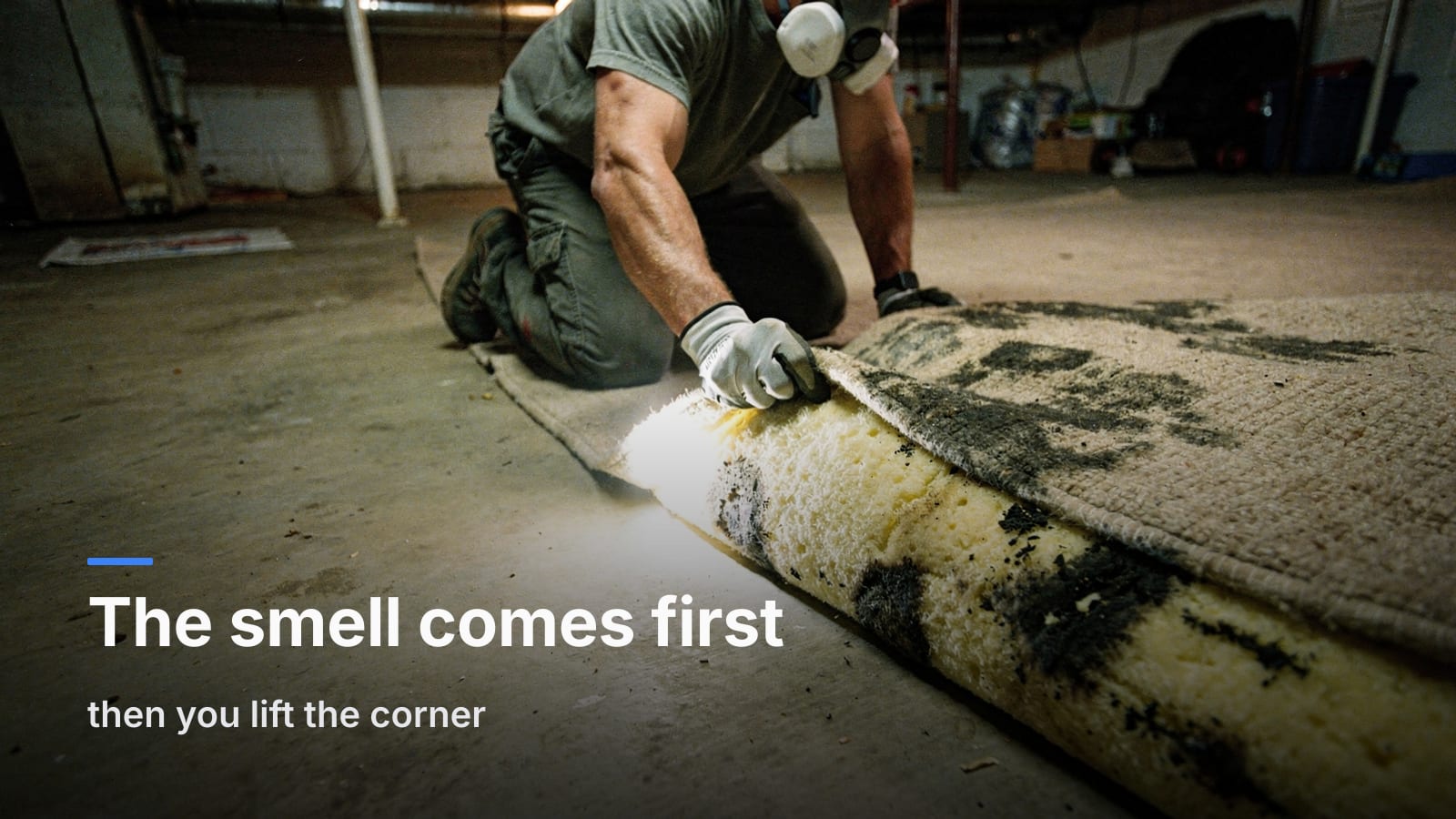
That's why almost every homeowner who finds carpet mold describes the same sequence: first the smell, then the search, then the unpleasant discovery when they pull up a corner.
Here's how to read the signs, figure out what's actually going on under there, and make the clean-it-or-replace-it call without guessing.
What mold on carpet actually looks like
| Sign | What you see or feel | What it usually means |
|---|---|---|
| Green, black, or gray blotches | Irregular fuzzy or powdery patches, often darker at the center | Active mold growth in the fibers or backing |
| White or grayish film | Chalky, cobwebby, or dusty surface coating, especially on rug backing | Early mold or mildew on a surface that's been damp |
| Yellow or brown staining | Ring-shaped or tide-line marks, sometimes with crusty edges | Water damage — mold may or may not have followed |
| Discolored padding | Dark blotches or orange-brown staining on the foam when you lift a corner | The pad stayed wet; this is the most common real find |
| Matted, stiff, or crunchy fibers | Carpet feels different underfoot in one spot | Fibers dried with contamination in them, or are still damp |
| Musty smell with no visible mark | Earthy, damp basement odor that's worse at floor level | Growth in the pad or subfloor beneath intact-looking carpet |
A few visual quirks worth knowing:
- Color is unreliable on carpet. Dyes, backing adhesives, and years of foot traffic distort what you see. A black patch on a beige rug may be mold; on a dark blue rug, the same growth may just look like a faded spot.
- Mold on carpet is rarely a neat circle. It follows moisture, so it tends to spread along a wall, under a window, out from a leak point, or in the shape of whatever spilled.
- The underside tells the truth. If you can safely lift an edge, the back of the carpet and the top of the pad show growth far earlier and more clearly than the pile does.
- Fuzz is a strong signal. Dirt lies flat and rubs away. Mold colonies often have visible texture — fuzzy, hairy, or velvety. If you're torn between the two, our guide on telling mold from ordinary dirt walks through the specific tests.
The smell comes first — and it means something
That musty odor is made of microbial VOCs, the gases mold releases as it grows. You can smell them long before a colony gets big enough to see, which is exactly why carpet mold tends to be discovered late.
Some useful details about the smell:
- It's worse at floor level. Get your nose close to the carpet in a few spots around the room. If the odor spikes in one area, that's your starting point.
- It gets stronger in humid weather. Warm, damp days make growth more active and the odor more noticeable. A basement that smells fine in February and awful in July is telling you something.
- It doesn't respond to cleaning products. If you shampoo the carpet and the smell comes back in a day or two, the source is underneath, not on the surface.
- It lingers in a closed room. Shut the door for a few hours, then walk in. Your nose resets, and the odor is obvious again.
If you're chasing a smell with no visible source anywhere, our guide on finding hidden mold when you can only smell it covers the systematic room-by-room search.
Where carpet mold actually happens
Mold needs moisture, and carpet mold happens exactly where moisture collects and can't evaporate.
Basements and below-grade rooms
The classic case. Concrete slabs wick moisture upward, basement air runs humid, and carpet laid directly on concrete traps it all. You don't even need a leak — sustained humidity above roughly 60% is enough. Look along exterior walls and in corners where air doesn't move.
Under and around windows
Condensation runs down the glass, soaks the sill, and drips into the carpet below. It's a small amount of water arriving over and over, which is worse than a one-time spill. If you also see growth on the frame or sill, the pattern is well documented in our post on mold on window sills.
After any leak or flood
Dishwasher line, water heater, a washing machine hose, a roof leak that found its way down a wall, a toilet overflow. The general rule cited by public health agencies: wet carpet that isn't fully dry within about 24 to 48 hours should be considered a mold risk.
Pet accidents and spills
Urine soaks through carpet into the pad and sits there. So does a spilled drink nobody blotted deeply enough. You cleaned the surface; the pad never dried.
Under furniture and area rugs
A rug on top of carpet, or a heavy piece of furniture sitting flat on the floor, blocks airflow. Add a little humidity and you get a persistent damp microclimate. Shifting a couch and finding a dark rectangle underneath is an extremely common discovery.
Along exterior walls in cold climates
Cold wall, warm humid room air, condensation at the base. The carpet edge stays slightly damp all winter.
Clean it or replace it: the honest rule of thumb
This is the decision most people are actually here for. The answer depends less on how bad it looks and more on three things: what the material is, how long it was wet, and what kind of water was involved.
A rug is often salvageable if:
- It's washable — cotton, synthetic, or another machine- or hose-washable material with no delicate backing.
- The moisture was clean water (condensation, a spilled glass, clean supply-line leak).
- It's been damp for a short time — days, not weeks.
- The affected area is small and confined to the rug itself.
- There's no foam or jute backing that's soaked through and stained.
For those, the approach is much like saving moldy clothes: take it outside, brush off loose growth while wearing a mask, wash it thoroughly, and — critically — dry it completely in sun and moving air. A rug that dries slowly indoors will simply regrow.
Carpet and pad usually need to go if:
- The pad is wet or stained. Foam padding is porous, open-celled, and effectively impossible to clean or fully dry in place. Once it's contaminated, it's a replacement item.
- The area is larger than about 10 square feet. That's the commonly cited threshold where cleanup stops being a DIY job and a professional should be involved.
- The water was contaminated — sewage backup, groundwater flooding, standing pet urine. Category 2 and 3 water means the carpet goes, regardless of appearance.
- It's been damp for weeks or months, as with an unnoticed slow leak or chronic basement humidity.
- It's an antique, wool, or delicate rug. Don't experiment. A professional rug cleaner can often save these, and DIY attempts usually can't be undone.
- The smell survives a proper cleaning. Persistent odor means persistent growth.
One more reality check: even if you clean the carpet successfully, you have not fixed anything until you fix the moisture source. A dehumidifier, a repaired gutter, a resealed window, a vapor barrier under basement flooring — whatever it takes. Otherwise you're just resetting the clock.
If you're going to clean it yourself
For small, recent, clean-water problems on a rug or a contained carpet spot:
- Ventilate the room. Open windows, run a fan pointed out a window, not one that just blows spores around the house.
- Wear protection. Gloves, eye protection, and at minimum an N95 respirator. Disturbing dried mold releases a lot of spores.
- Never dry-brush or vacuum dry growth indoors. That aerosolizes it. Dampen first, or take the rug outside.
- Take small rugs outside to clean and dry whenever possible.
- Clean with detergent and water. Scrubbing physically removes growth, which matters more than what chemical you use. Bleach is not recommended on porous materials and doesn't penetrate carpet backing.
- Dry aggressively. Fans, dehumidifier, open windows on a dry day. The goal is fully dry within 24 hours, including the backing.
- Check again in a week. If the smell or the spot is back, cleaning didn't reach it.
If at any point you find the pad is wet, the growth extends under a wall, or the affected area keeps growing — stop and get a professional assessment.
When to call a pro
Call a mold remediation contractor or a certified inspector if:
- The affected area is bigger than roughly 10 square feet.
- Carpet was soaked by flood water, sewage, or a long-running leak.
- Growth keeps returning after cleaning.
- You suspect it's spread into the subfloor, walls, or HVAC system — black dust around floor vents can be a clue, which we cover in black specks in AC vents.
- Someone in the household has asthma, allergies, a compromised immune system, or symptoms that improve when they leave the house.
A professional can also determine whether the subfloor beneath the carpet is affected, which is the part homeowners consistently underestimate. Plywood and OSB absorb water and hold it, and carpet coming up sometimes reveals a bigger problem than anyone expected.
Not sure what you're looking at?
If you've pulled back a corner and you're staring at a blotch you can't identify, you can upload a photo for an instant AI mold analysis and get a probability read in seconds, plus a fuller report by email. It's a screening aid, not a lab test and not a substitute for a certified inspector — but it's a fast, free way to decide whether you're dealing with an old coffee stain or something that needs real attention.
Frequently asked questions
Why does my carpet smell musty but look completely fine?
Because the growth is underneath. Carpet backing and foam padding hold moisture much longer than the visible pile, so mold can be well established in the pad while the surface looks and feels normal. Lift a corner near the strongest smell and inspect the underside of the carpet and the top of the pad.
Is mold under carpet dangerous?
It's a genuine indoor air quality concern. Walking on carpet with mold beneath it pushes spores and musty gases up into the room air with every step. Public health agencies including the EPA and CDC note that mold exposure can trigger respiratory symptoms and allergic reactions, particularly in people with asthma, allergies, or weakened immune systems. It's not a reason to panic, but it is a reason to act rather than wait.
Will steam cleaning kill mold in carpet?
Not reliably, and it can make things worse. Steam cleaning adds a lot of moisture, and if the carpet doesn't dry completely within about 24 hours, you've fed the problem. It also doesn't reach the pad. Professional hot-water extraction with proper drying equipment is a different matter — the risk is with DIY machines that leave carpet damp for days.
How long does it take for mold to grow in wet carpet?
Under the right conditions — warm room, humid air, no airflow — mold can begin establishing within 24 to 48 hours of the carpet getting wet. That's why the standard advice after a leak is to extract water and run fans and a dehumidifier immediately rather than waiting to see if it dries on its own.
Can I just replace the padding and keep the carpet?
Sometimes, if the carpet itself is clean synthetic fiber, the water was clean, and the contamination is clearly limited to the pad. But pulling up, cleaning, drying, and re-stretching wall-to-wall carpet is skilled work, and once you've paid for that labor the savings over new carpet are often small. Get a quote for both before deciding.
Does black mold grow in carpet?
Stachybotrys — what people usually mean by "black mold" — prefers very wet cellulose materials like drywall paper and wood, so it's more likely in the subfloor beneath a chronically soaked carpet than in the carpet fibers themselves. Plenty of other molds that grow in carpet are also dark-colored. You can't identify species by color; here's how black mold actually compares to other common molds.
If you've found a suspicious patch on a carpet or rug, upload a photo at /test for a free instant analysis — a quick first step, not a diagnosis.
Ready to put this into action?
Not sure what you are looking at? Upload a photo and get a free instant mold analysis from Mold Detector AI.
Launch Mold Detector AIRecommended next reads
- Is It Mold or Dirt? A Homeowner's Guide to Telling the Difference
- I Smell Mold But Can't See It: A Homeowner's Guide to Finding Hidden Mold
- Mold on Window Sills: Why It Happens and How to Stop It for Good
- Can You Save Moldy Clothes? A Homeowner's Guide to Washing vs. Tossing
- Black Specks in Your AC Vents: Is It Dust or Dangerous Mold?
- Is It Dangerous Black Mold? Stachybotrys vs. Other Common Molds